
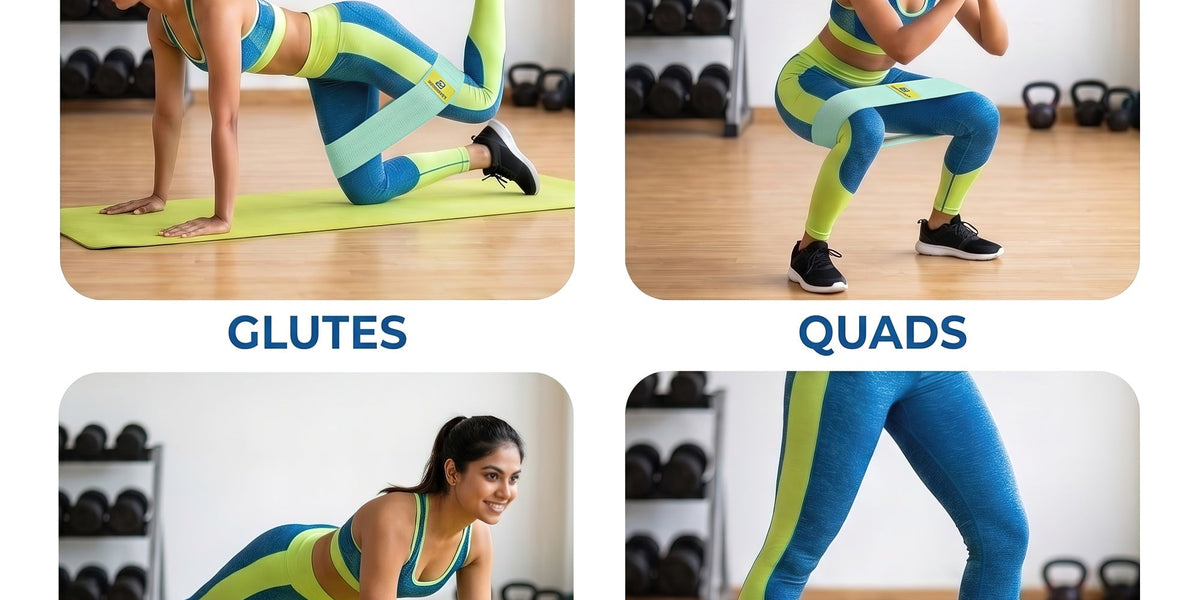
For years, getting stronger seemed to mean a gym membership, a rack of dumbbells or a corner of the house given over to heavy equipment. It doesn't have to. Functional home workouts have become one of the most popular ways to train, and resistance bands sit at the centre of that shift. They're light, quiet, affordable, easy on your joints, and small enough to live in a drawer. This guide covers how to choose the best resistance bands for your home workouts, how hip bands and mini loops differ, and a 20-minute full-body circuit you can start today.
Why resistance bands work so well at home
Bands create tension that increases as you stretch them. The start of each movement feels gentler and the effort builds towards the strongest part of the range, which makes training feel approachable for beginners while still challenging people with more experience. There's no heavy weight to drop, no momentum to manage, and nothing to balance overhead, so most people find bands comfortable on knees, hips and shoulders. A complete band set costs a fraction of a home gym and packs into a pouch you can take anywhere.
Hip bands vs mini loop bands: which should you buy?
The biggest decision when you buy resistance bands online is the type of band. Both are useful, and many people end up owning one of each.
Fabric hip bands: best for your lower body
Fabric hip bands are wide, woven bands with grip on the inside. Because they're wide and firm, they stay in place above your knees and are far less likely to roll up, pinch or snap against your skin. That makes them the better choice for lower-body and glute work: squats, glute bridges, lateral walks and clamshells, where you want steady tension pushing your knees inward so your hips have to work to press them out.
- Comfortable on bare skin, leggings or shorts
- Stay put during squats and bridges
- Firmer resistance, ideal for hips and glutes
Mini loop bands: best for versatility
Mini loops are smaller and lighter than hip bands. Many are made of thin latex, while others, like Beneindio's, are made of latex-free fabric. They're lighter to move and adapt to far more exercises: upper-body pulls and presses, shoulder raises, ankle and wrist mobility, warm-ups and activation work. Because they come in a range of resistances, they're also easy to progress with.
- Lighter levels suit upper-body and mobility moves
- Great for warm-ups and travel
- Easy to swap as you get stronger
Quick rule: choose wide hip bands for squats and glute work, and lighter mini loops for everything above the hips and for mobility. If you're setting up a small home gym, having both covers almost every exercise. For a detailed comparison of band materials, read Fabric vs Latex Resistance Bands.
The 20-minute full-body circuit
Do this circuit two or three times a week. Work through the moves in order, rest 60 seconds at the end, and complete three rounds. Start with a lighter band than you think you need; smooth, controlled reps matter more than resistance.
- Warm-up (3 minutes): march on the spot, arm circles, hip circles and a few bodyweight squats.
- Glute bridge with a fabric hip band, 12 reps: lie on your back, band just above your knees, feet flat. Press your knees gently out against the band as you lift your hips, pause for a second at the top, lower slowly.
- Lateral walk with a fabric hip band, 10 steps each way: band above the knees, knees softly bent, chest up. Take small, controlled steps sideways without letting your knees cave in.
- Clamshell with a fabric hip band, 12 each side: lie on your side with knees bent and stacked. Keeping your feet together, lift the top knee against the band, then lower slowly.
- Banded squat, 12 reps: keep the hip band on and sit back as if onto a chair, pressing your knees out as you stand.
- Shoulder raise with a mini loop band, 10 reps: loop a light band around both wrists, arms straight in front at chest height. Keeping tension on the band, raise your arms slowly overhead, then lower.
- Band pull-apart with a mini loop band, 12 reps: hold the band at chest height and pull it apart, squeezing your shoulder blades together.
- Cool-down (2 minutes): hip flexor stretch, chest stretch and slow breathing.
How to progress: once 12 to 15 reps feel easy with good form, move up a resistance level, slow the tempo, or add a pause at the hardest point of each rep.
Setting up your home workout space
You don't need a dedicated room. A clear patch of floor about the size of a yoga mat, a sturdy door for anchoring bands, and a basket or drawer to keep everything together is enough. Keeping your bands visible makes it far more likely you'll use them.
Maintenance and care
- Keep them out of the sun and heat. Direct sunlight and high temperatures weaken latex and elastic threads. Store bands in a drawer or pouch, not on a sunny windowsill or in a hot car.
- Clean gently. Wipe latex bands with a damp cloth. Fabric bands can usually be hand-washed in cool water and air-dried away from direct sun.
- Check before you stretch. Look for small nicks, tears or thinning spots, and loose stitching on fabric bands. Replace any band that shows damage.
- Avoid sharp edges. Rings, long nails and rough floors can damage bands.
Start your routine
You don't need bulky equipment to build real strength, just a couple of good bands and a few minutes you set aside for yourself. Explore our fabric Hip Bands Pack of 3 for lower-body work and our Mini Loop Resistance Bands Pack of 5 for everything else, or browse the full Home Workout Gear collection. New to bands? Our 5 real benefits and starter routine is a gentle place to begin, and our 15 mini loop band exercises give you plenty of moves to choose from.
If you're pregnant, recovering from surgery or managing an injury or health condition, please check with a doctor or physiotherapist before starting a new exercise routine.