
Hours at a laptop, a long commute, an evening on the sofa: by the end of the day many of us stand up and feel it in our hips. That tight, creaky feeling when you first get up is one of the most common side effects of modern life. The good news is that it usually responds well to a little regular movement. Here's why sitting makes your hips feel stiff, and six simple moves to help you feel looser at home.
Why sitting makes your hips feel stiff
When you sit, your hips stay bent at roughly 90 degrees. Over hours, the muscles at the front of your hips (the hip flexors) spend a long time in a shortened position, while the glutes at the back do very little work. Joints also like movement: staying in one position for a long time is often what makes them feel stiff, more than any single movement does.
The result is that familiar feeling: tight at the front of the hips, weak or "switched off" at the back, and stiff when you stand up. The answer isn't to stop sitting altogether. It's to move more often, stretch what's tight, and strengthen what's been resting.
6 moves to ease hip stiffness from sitting
Do these 4 or 5 times a week. The whole sequence takes about 10 to 12 minutes. Move slowly, breathe steadily, and stop if anything feels sharp or painful.
1. Half-kneeling hip flexor stretch
Kneel on one knee on a soft surface, other foot flat in front. Tuck your tailbone slightly under and shift your weight forward until you feel a stretch at the front of the back hip. Keep your chest tall.
Hold 30 seconds each side, twice.
2. 90/90 hip switch
Sit on the floor with both knees bent at about 90 degrees, both legs falling to one side. Keeping your chest upright and hands behind you for support, slowly rotate both knees to the other side. This gently moves your hips through rotation, which they rarely get when you sit.
8 to 10 slow switches.
3. Figure-four stretch
Lie on your back or sit on a chair. Cross one ankle over the opposite knee and gently draw the legs towards you (or lean forward from the chair) until you feel a stretch in the outer hip and glute.
Hold 30 seconds each side.
4. Glute bridge with a hip band
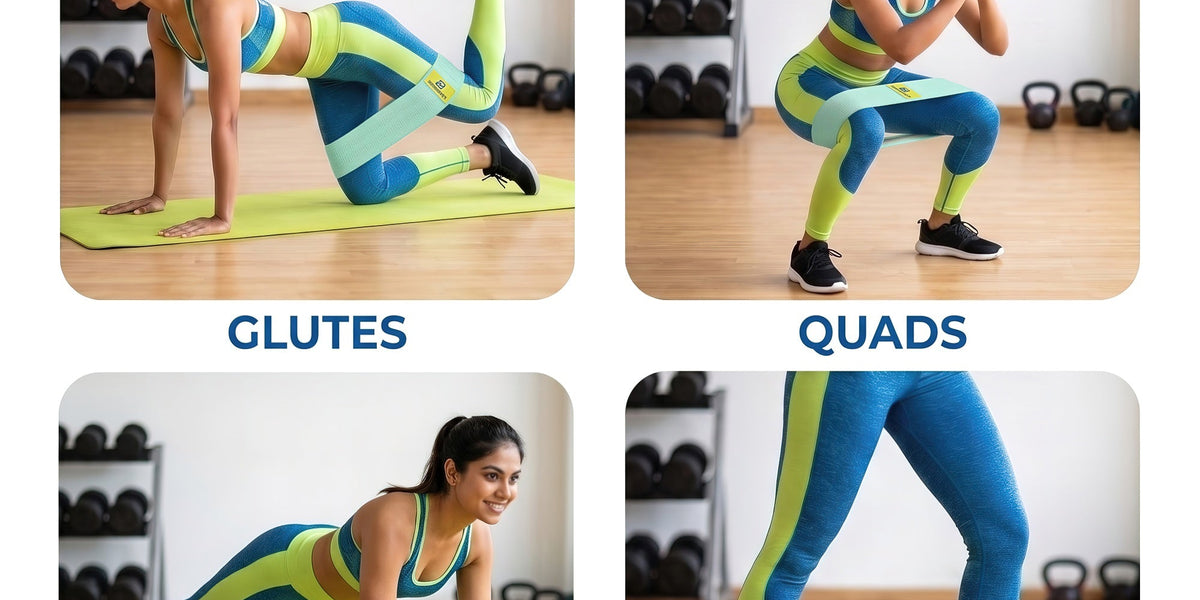
Lie on your back, knees bent, with a fabric hip band just above your knees. Press your knees gently outward against the band, then lift your hips by squeezing your glutes. Pause at the top, then lower slowly. This wakes up the muscles at the back of your hips that sitting leaves inactive.
2 sets of 12. Start with the Green (light) band.
5. Banded clamshell
Lie on your side with knees bent and stacked, hip band above your knees. Keeping your feet together, lift your top knee against the band, then lower with control. This strengthens the side of your hips, which helps keep your knees and pelvis steady when you walk and climb stairs.
2 sets of 12 each side.
6. Lateral band walk
Stand with the hip band above your knees, feet hip-width apart and knees softly bent. Take small, controlled steps sideways, keeping tension on the band and your knees in line with your toes.
10 steps each way, twice.
A simple 10-minute hip routine
| Move | Amount |
|---|---|
| Half-kneeling hip flexor stretch | 30 seconds each side |
| 90/90 hip switch | 8 switches |
| Glute bridge with hip band | 12 reps |
| Banded clamshell | 12 each side |
| Lateral band walk | 10 steps each way |
| Figure-four stretch | 30 seconds each side |
Do the circuit once on busy days, or twice when you have a little more time. Stretches first and last bookend the strength moves, so you finish feeling loose.
Small habits that help through the day
- Stand up every 30 to 45 minutes. Even a one-minute walk to refill your water bottle breaks up long stretches of sitting.
- Change position often. Cross-legged on the sofa, sitting on the floor, standing at the kitchen counter: variety helps.
- Take calls on your feet when you can.
- Use the stairs instead of the lift for a floor or two.
- Squat to pick things up rather than always bending from the waist.
Which hip band should you use?
For hip moves, wide fabric bands are usually more comfortable than thin latex loops because they stay flat above your knees and don't roll. The Beneindio Hip Bands, Pack of 3 are made from latex-free elasticated cotton in three levels:
- Green (light): clamshells and your first few weeks
- Pink (medium): side walks and squats once Green feels easy
- Purple (heavy): glute bridges when you're ready for more
Not sure about materials? Read Fabric vs Latex Resistance Bands.
Frequently asked questions
Why do my hips feel stiff after sitting?
Long periods in one position, with your hips bent, can leave the front of your hips feeling tight and the muscles at the back underused. Moving more often usually helps.
How often should I stretch tight hips?
A short routine 4 or 5 times a week, plus regular movement breaks during the day, is a practical starting point.
Is it better to stretch or strengthen?
Both. Stretching eases the front of the hips; strengthening the glutes and outer hips helps support them. This routine combines the two.
Can I do these exercises at my desk?
The figure-four stretch works seated on a chair. The others need a little floor space, such as a rug or mat.
When should I see a professional?
If you have hip pain that is sharp, persistent, gets worse, or comes with swelling, clicking with pain, or numbness, please see a doctor or physiotherapist before exercising.
Move a little, often
Stiff hips are a signal, not a verdict. A few minutes of movement, a band within reach and a reminder to stand up now and then can make a real difference to how you feel by the end of the day. No pressure, no perfect routine. Just you, showing up for you.
Shop Beneindio Hip Bands, Pack of 3 · Read the 4-week posture habit plan