
When people think about getting stronger, they usually picture bigger muscles: arms, shoulders, legs. The foundations get far less attention. Yet much of your everyday strength depends on your hands and how freely your joints move. Carrying groceries, lifting a child, opening a stubborn jar, holding a plank or finishing a set of rows all start with your grip. This guide explains how to improve grip strength at home, how to use a hand grip strengthener sensibly, and why mobility work is the other half of the equation.
Why grip strength matters
It supports almost every other exercise
Any movement where you hold something, from band rows to carrying a heavy bag, relies on your grip. When your hands tire first, the rest of your body never gets fully worked. A stronger grip lets you keep good form for longer.
It helps with everyday tasks
Grip is functional strength in its purest form. Carrying shopping, lifting and holding, turning, twisting and squeezing all rely on the muscles of your hands and forearms. Many people notice everyday jobs feel easier as their grip improves.
It's a useful marker of overall strength
Grip strength is widely used in research as a simple, practical measure of overall muscular strength. It's quick to train, needs almost no space, and is something you can work on while doing other things.
It supports joint stability
Strong hands and forearms help keep your wrists and elbows supported when you push, pull and carry, which is why grip work is a good companion to any strength routine.
How to use a hand grip strengthener
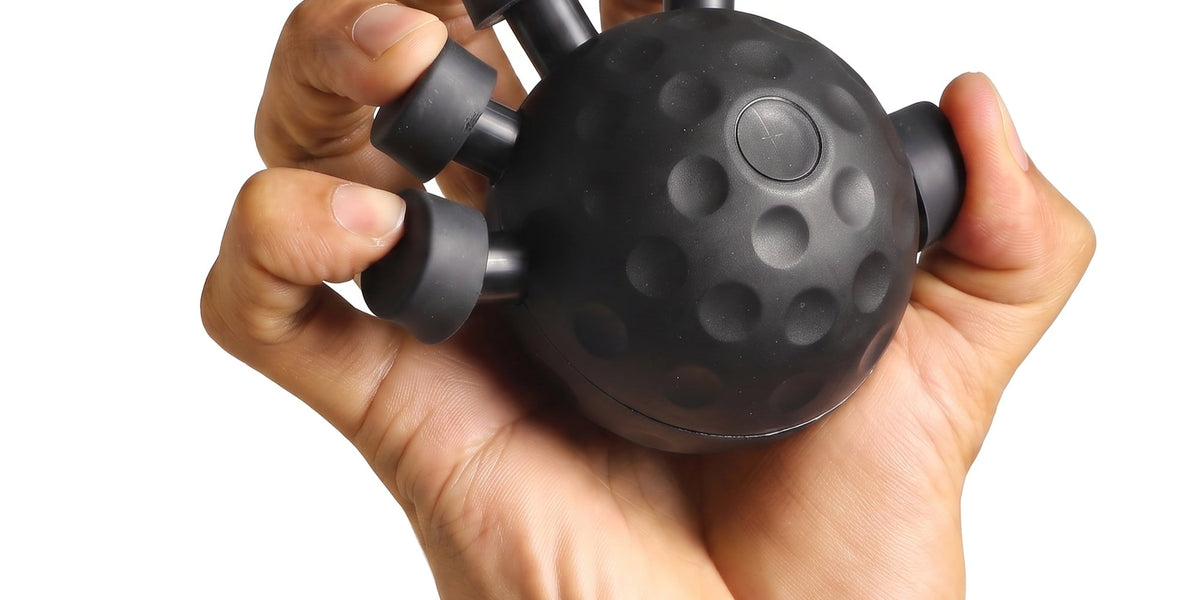
A hand grip strengthener is one of the easiest pieces of home fitness equipment to fit into your day: use it at your desk between calls, on the sofa or while waiting for the kettle. The key is structure, so your forearms get stronger without getting overworked.
A simple starting routine (3 times a week)
- Controlled squeezes: 2 to 3 sets of 10 to 15 reps per hand. Squeeze fully, hold for a second, then release slowly.
- Squeeze and hold: 3 holds of 10 to 20 seconds per hand at a firm but manageable effort.
- Finger work: squeeze using just your thumb with two fingers at a time, 8 to 10 reps per combination.
Progress gradually
- Once 15 smooth reps feel easy, add a set, lengthen your holds, or slow the release.
- Train on alternate days rather than daily; your forearms need recovery time to get stronger.
- Train both hands equally, even if one feels stronger.
Avoid overtraining
Mild muscle fatigue is normal. Sharp pain, tingling or numbness in your hands or wrists is not: stop and rest, and speak to a doctor or physiotherapist if it continues. If you type or use a phone for long hours, balance grip work with the stretches below.
Tension and release: mobility and active recovery
Strength and mobility go together. Squeezing, lifting and sitting at a desk all tighten muscles; mobility work gives them back their range. A few minutes of stretching after training helps you feel less stiff and keeps you moving well.
Hands and forearms
- Wrist flexor stretch: arm straight, palm up, gently draw your fingers back with the other hand. Hold 20 to 30 seconds.
- Wrist extensor stretch: arm straight, palm down, gently bend your wrist down. Hold 20 to 30 seconds.
- Finger spreads: open your hand as wide as you can, hold for 3 seconds, relax. Repeat 10 times.
Upper back, hips and spine
- Thoracic rotations: on hands and knees, one hand behind your head, rotate slowly, 8 each side.
- Cat-cow: 8 to 10 slow rounds to move your whole spine.
- Half-kneeling hip flexor stretch: 30 seconds each side.
- Child's pose: 30 to 60 seconds of slow breathing.
Choosing the right surface
Floor-based mobility work is far more comfortable on a good mat. Look for one with enough cushioning to protect your knees and wrists, a non-slip surface that holds when your hands are sweaty, and a size that fits your space. A dense mat stays stable during kneeling and all-fours positions better than a thin, squashy one.
Putting it together: a 15-minute foundation session
- Grip strengthener: 2 sets of 12 controlled squeezes per hand.
- Squeeze and hold: 2 holds of 15 seconds per hand.
- Band pull-aparts with a resistance band: 2 sets of 12.
- Wrist and forearm stretches: 2 minutes.
- Thoracic rotations, cat-cow and child's pose: 5 minutes.
Build your foundation
Real strength starts with the parts of your body you use every day. Our Hand Grip Strengthener (also in pink) is a simple way to start, and our Resistance Bands Set of 3 covers your upper back and shoulders. For more daily mobility, read our 4-week posture habit plan.
These exercises are general fitness guidance, not medical advice. If you have a wrist, hand or elbow injury or ongoing pain, please speak to a doctor or physiotherapist first.