
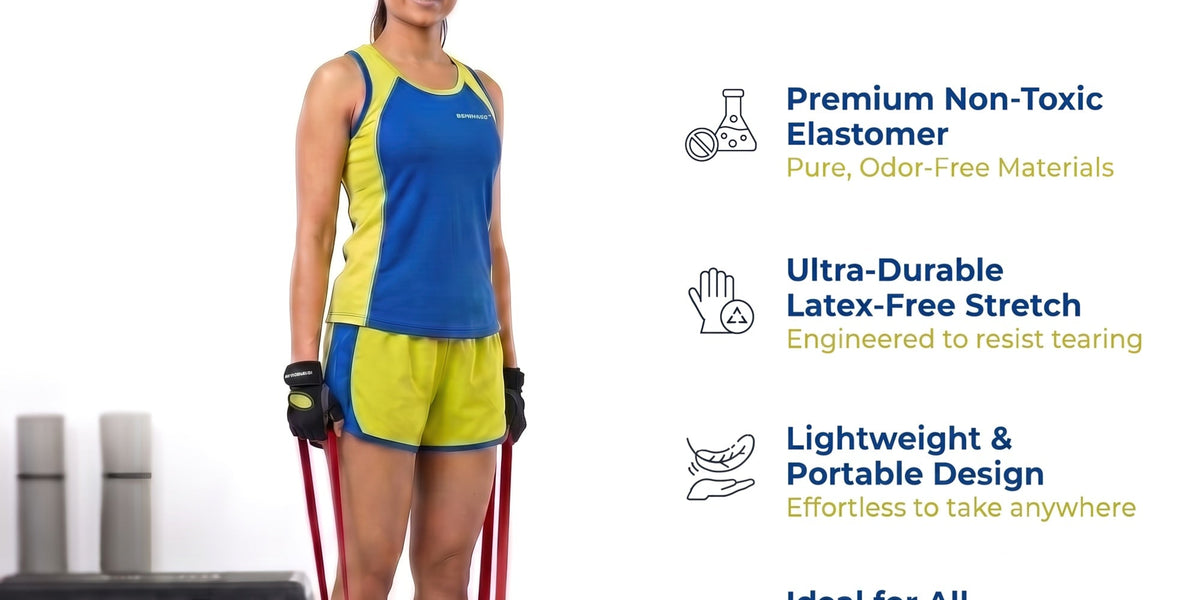
Somewhere in our 40s, many of us notice small changes: stairs feel a little harder, carrying shopping takes more effort, and getting up from the floor isn't quite as easy as it was. Strength training is one of the most practical ways to keep feeling capable in everyday life, and you don't need heavy weights or a gym to do it. Resistance bands are a joint-friendly, space-saving way to build real strength at home. Here's how to get started.
Why strength training matters after 40
Muscle strength naturally tends to decline with age if we don't use it, and that decline can quietly make everyday tasks feel harder. The World Health Organization recommends that adults do muscle-strengthening activities on two or more days a week, and that advice applies at every age.
Regular strength training can help you:
- Feel stronger in everyday movements: lifting, carrying, climbing stairs, getting up from the floor
- Support your balance and stability
- Keep your joints moving through their full range
- Build confidence in what your body can do
This isn't about changing how you look. It's about feeling capable on your own terms, for years to come.
Why resistance bands suit women over 40
- Joint-friendly: bands provide smooth tension without heavy loads or impact, so most people find them comfortable on knees, shoulders and wrists.
- Easy to adjust: change band, shorten your grip or slow the movement to make an exercise easier or harder.
- Space-saving: a set fits in a drawer and works in a living room, bedroom or hotel room.
- Safe to start alone: there's no heavy weight to drop or balance overhead.
A 20-minute resistance band workout for women over 40
Do this workout 2 or 3 times a week, with a rest day between sessions. Warm up for 3 minutes first: march on the spot, roll your shoulders, and do a few gentle bodyweight squats. Then complete 2 to 3 rounds of the circuit, resting about a minute between rounds.
1. Band squat to chair
Stand in front of a sturdy chair with a hip band above your knees. Sit back slowly until you lightly touch the chair, pressing your knees gently out, then stand tall. The chair gives you a safe target and builds confidence.
10 to 12 reps
2. Seated band row
Sit on the floor or a mat with legs extended and loop a long resistance band around your feet. Pull your elbows back close to your sides, squeezing your shoulder blades together, then release slowly. Great for your upper back and posture.
12 reps
3. Glute bridge with hip band
Lie on your back, knees bent, band above your knees. Press your knees outward and lift your hips, pause, then lower slowly.
12 reps
4. Standing band chest press
Wrap a long band around your upper back, holding an end in each hand at chest height. Press both hands forward until your arms are straight, then return slowly.
10 to 12 reps
5. Lateral band walk
Band above your knees, knees softly bent. Take small, controlled steps sideways. This strengthens the sides of your hips, which helps with balance and steady walking.
10 steps each way
6. Band overhead press
Stand on the middle of a long band, holding an end in each hand at shoulder height. Press your hands overhead without arching your back, then lower slowly. Use a light band to start.
10 reps
7. Pallof press
Anchor a band at chest height (closing it in a door works well) and stand side-on. Hold the band at your chest and press it straight out, resisting the pull to rotate. A simple, standing way to strengthen your core.
8 reps each side
Finish with 3 minutes of gentle stretching: chest, hip flexors, hamstrings and a few slow breaths.
How to progress safely
- Start light. Good form with a lighter band beats a struggle with a heavier one.
- Use the 12-rep test. When 12 to 15 slow, controlled reps feel comfortable, move up a band level.
- Slow down. Taking three seconds to return from each rep makes any band more challenging.
- Be consistent. Two or three sessions every week, done for months, matter more than any single hard workout.
- Rest between sessions. Your muscles get stronger during recovery.
Which bands to start with
- Resistance Bands Set of 3 for rows, presses and full-body moves.
- Hip Bands, Pack of 3 for squats, bridges and side walks. Wide, latex-free fabric stays put above your knees.
- Mini Loop Bands, Pack of 5 for lighter shoulder work, warm-ups and travel.
Frequently asked questions
Can you build strength with resistance bands after 40?
Yes. Bands can provide enough resistance to challenge your muscles, as long as you choose the right level and progress gradually.
How often should women over 40 strength train?
Two or three sessions a week is a practical goal, in line with WHO guidance of muscle-strengthening activity on at least two days a week.
Is strength training safe if I'm new to exercise?
For most people, starting with light bands and slow, controlled movements is a gentle way to begin. If you have a health condition, an injury, or haven't exercised for a long time, check with a doctor or physiotherapist first.
Do I need to work out for an hour?
No. A focused 20-minute session, done consistently, is a great place to start.
Strength on your own terms
You don't need a gym, heavy weights or a perfect schedule to get stronger. A couple of bands, a little floor space and 20 minutes a few times a week is enough to begin. Pace in your own space.
Want more? Read The Ultimate Guide to Building Strength at Home with Resistance Bands or try our 6 moves for stiff hips.